
Room 3: Murder at Fremantle’s Federal Hotel
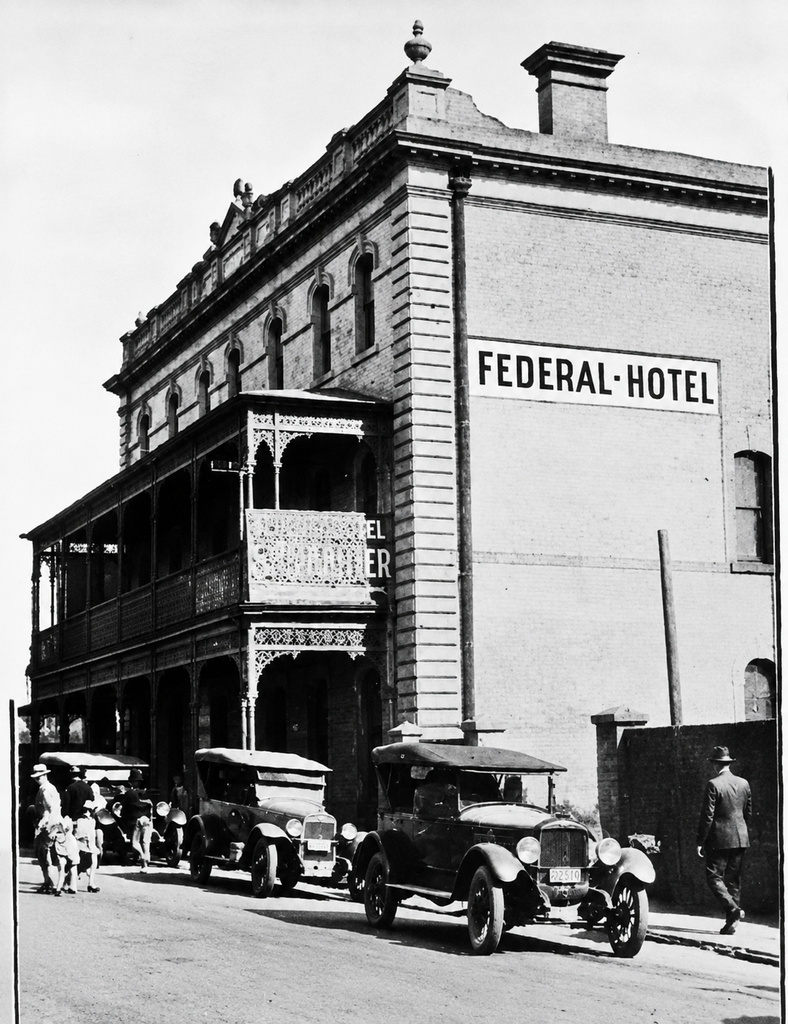
On Monday, 7 February 1927, three people arrived at the Federal Hotel in William Street, Fremantle.
Nothing particularly remarkable marked their arrival. A man and a young woman accompanied by a small boy booked a room under the name of Mr and Mrs Martin. They had recently been staying at Rockingham and had travelled into Fremantle. They ate at the hotel and later went out for the evening, returning at about 10.30.
By the following morning, the man had gone.
The woman and child remained in Room 3.
Before noon, both would be found dead.
The newspapers soon called it the Fremantle Murder, the Federal Hotel Murder and the Hotel Bedroom Horror. Police would search across Perth and Fremantle for a mysterious man named Jack Thomas. Newspapers would speculate about jealousy, alcohol and insanity.
But behind the sensational headlines were a 24-year-old woman, Lillian Josephine Martin, and her three-year-old son, Daniel Charles Martin.
The story that brought them to Room 3 had begun long before they walked through the doors of the Federal Hotel.
A publican’s daughter
Lillian was born Lillie Josephine Bentley in 1902 at Peak Hill, Western Australia, the daughter of Daniel Bentley and Elizabeth Ladham.
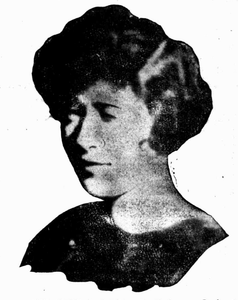
Hotels were familiar places to the Bentley family. Lillie’s father was a publican holding hotel licences during her childhood. Long before the Federal Hotel became associated with her name, hotels had formed part of the landscape of Lillie’s early life.
In 1922, she married Felix Martin at Boulder, Kalgoorlie, Western Australia (part of the Western Australian Goldfields).
Their son, Daniel Charles Martin, was born in Perth in 1923. Two years later, Joan Elizabeth Martin, their second child, was born, only living for a month.
By 1927, the surviving family of three were residing in a lodging house on Newcastle Street, Perth.
Their marriage, however, was in difficulty.
Contemporary newspaper accounts need to be approached cautiously here. Much of the reporting after Lillian’s death was deeply judgemental about her drinking, smoking and relationships with men. The language reflected both the sensationalism of the newspapers and the expectations placed upon women in the 1920s.
There is nevertheless evidence that Felix and Lillian’s relationship had deteriorated.
Felix was a returned serviceman suffering the continuing effects of a severe wartime wound. According to contemporary accounts, a bullet had passed through his mouth and throat, leaving an injury that continued to require medical treatment.
At the Newcastle Street lodging house, Felix, Lillian and Daniel lived alongside another boarder.
His name was Jack Thomas.
Jack Thomas
Jack Thomas was an Englishman, apparently from Kent, probably in his late thirties.
Those who encountered him offered remarkably similar descriptions. He was quiet, reserved and reluctant to discuss his past. He periodically went away to Mandurah, where he fished rather than worked. He appeared to have enough money to live without regular employment.
At the Newcastle Street house he became friendly with the Martins.
According to the daughter of the lodging-house proprietor, Jack was generous. He bought presents for members of the household and regularly returned from shopping carrying fruit, nuts and sweets. For Lillian, there were cosmetics, face powder and beer.
He also became fond of Daniel.
Daniel was known around Newcastle Street by a nickname: “Tyke.”
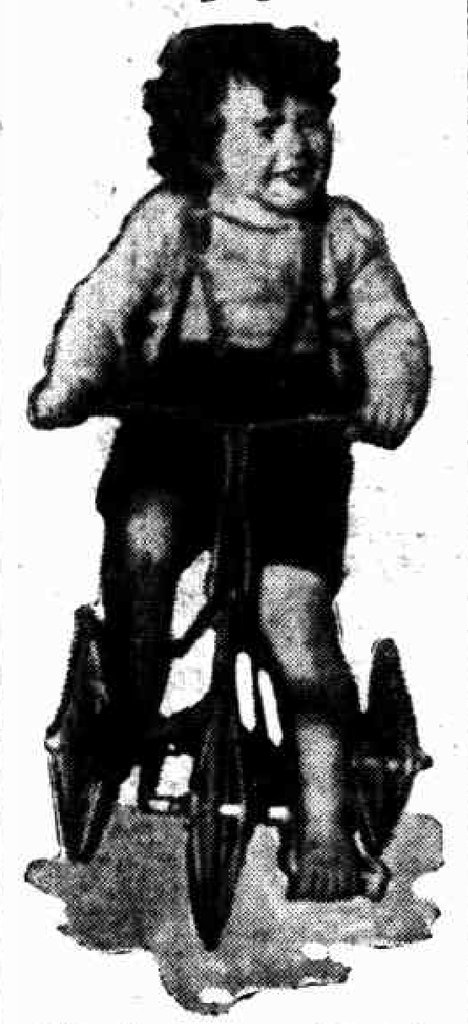
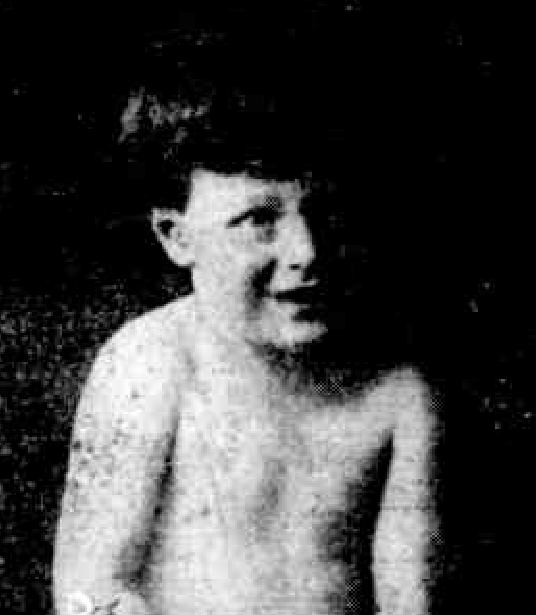
The boy was remembered as a familiar little figure in the neighbourhood, riding his tricycle to the shops and greeting people along the way. A contemporary photograph shows him astride that tricycle, smiling at the camera.
One neighbour remembered him simply as “a lovely little fellow.”
By early 1927, however, relationships inside and around the lodging house had become complicated.
One surviving letter gives us a rare opportunity to hear Lillie describe something of her circumstances herself, rather than through the filter of newspaper reporters and witnesses interviewed after her death.
On 12 January she wrote to Jack, who was then at Mandurah. Felix—whom she called “Bronk”—was still in hospital. She had tried unsuccessfully to find work and wrote that she wasn’t able to collect her pension.
She reluctantly asked Jack for some money:
“I hate to have to ask, but you are the only one I can turn to.”
The letter also complicates some of the later newspaper descriptions of her drinking. Lillie told Jack she had not been drinking for more than a fortnight apart from a glass of stout the previous Sunday, adding that drinking was “no good in the long run.”
She finished with best wishes “from myself and Tyke” and signed:
“Yours with love,
LIL.”
Whatever the exact nature of their relationship, the letter revealed that by January 1927 there was affection between Lillie and Jack and that she was relying upon him for at least some financial assistance.
Thomas, meanwhile, appears to have become increasingly concerned when Lillie failed to answer his correspondence.
A letter he wrote from Mandurah on 15 January survives because it was later produced at the inquest. Jack told her he was “utterly amazed” that he had not received a reply to a registered letter. He had been going to the post office each day and complained that this was now the third letter he had written.
“Why did you ask me to write if you did not intend to reply?” he asked.
The letter does not establish what Jack felt beyond what he actually wrote. It does, however, show the importance he was placing upon maintaining contact with Lillie in the weeks before the murders.
A marriage breaks down
On Saturday, 22 January, Felix returned from hospital and found another man with Lillian.
This incident initially appeared in the newspapers through the recollections of other residents, but Felix subsequently gave his own account to Truth.
“I returned home from the hospital, and found a strange man with my wife in her room.”
Felix said he attacked the man and then went to the police station because he believed he might have killed him.
“I left home next day,” he said.
The unidentified man was not Jack Thomas.
Around this same period, Lillian was corresponding with Jack while he was away at Mandurah. The daughter of the lodging-house proprietor recalled sending a telegram for her:
“Received money and letter, letter following, love, Lil.”
By 29 January, Lillian and Daniel had left Newcastle Street.
Jack left two days later but then returned to collect Daniel’s tricycle.
Soon afterwards, Lillian, Daniel and Jack were together at Rockingham.
There, Jack was apparently passing himself off as Lillian’s husband.
Nine days at Rockingham
The three stayed near the Rockingham Hotel.
At the later inquest, carpenter Frank Moody recalled meeting the couple there. He had been introduced to them as Mr and Mrs Martin, although the man was actually Thomas.
Moody remembered Thomas regularly visiting the Rockingham Hotel and returning with bottles of beer.
More significantly, he recalled that relations between Lillian and Jack sometimes appeared strained. On one occasion, Moody believed Jack became jealous when he sat between them.
Another acquaintance, Henry Keely, later gave evidence about an earlier conversation with Thomas. Thomas had spoken of a woman he knew in Newcastle Street to whom he had given money. According to Keely, Thomas complained that another man was becoming too friendly with her and threatened to “put a bullet in him.”
This would later contribute to a theory that jealousy lay behind what happened at the Federal Hotel.
But Jack Thomas never left an explanation.
On Monday, 7 February, the three left Rockingham for Fremantle.
Their destination was the Federal Hotel.
The Federal Hotel
Standing prominently in William Street, the Federal was a substantial Fremantle hotel. It is a two-storey corner building with verandahs overlooking the street and businesses clustered around it.
At about 9.30 on the morning of 7 February, Thomas, Lillian and Daniel arrived.
Barman Edward Smith later told the inquest that the man and woman booked accommodation under the names Mr and Mrs Martin.
The hotel register survived long enough to be photographed by the press. The Mirror reproduced the relevant section only days later.
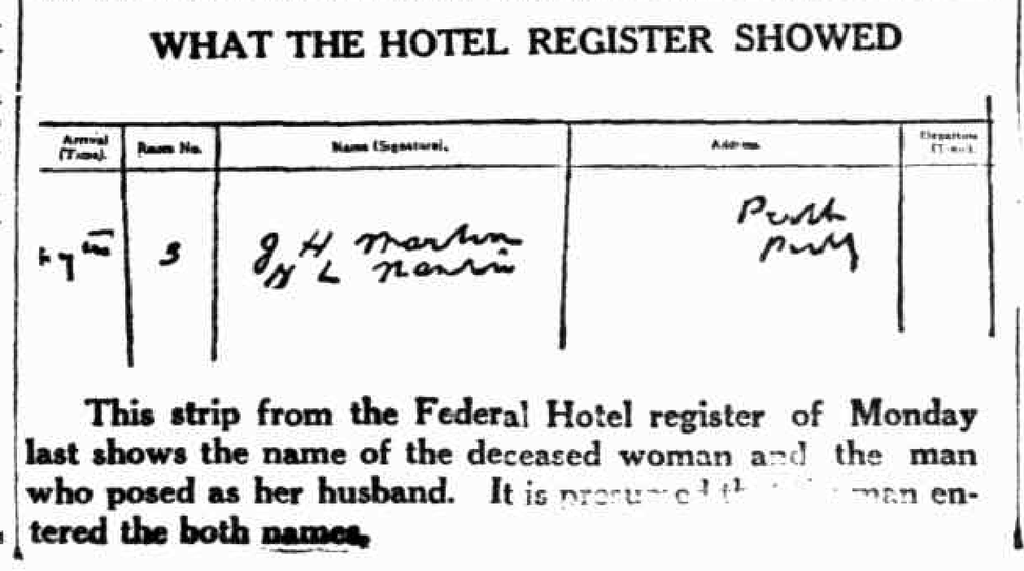
They were given a front upstairs bedroom overlooking the balcony:
Room 3.
They had two meals at the hotel. That evening the three went out, apparently to the pictures, and returned at about 10.30.
Room 4, immediately next door, was occupied by retired Fremantle Chief Harbour Master Captain Frank Winzar and his wife.
Winzar went to bed at about 10 o’clock. At that point, he later testified, everything in Room 3 seemed quiet.
Sometime later he was awakened.
He heard something heavy fall to the floor.
At about the same time, there was another noise which he described as sounding like someone vomiting.
Winzar got out of bed, switched on his light and looked at his watch.
It was three minutes to one.
Moments later he heard the town clock strike the hour.
The sounds were not repeated, and Winzar heard nothing more during the night.
At around 7 o’clock the following morning, while Winzar was away from the room taking a bath, his wife heard a child give what she described as a short scream. She could not tell whether it came from the street or from somewhere within the hotel.
Sometime during the night of 7 February or the early hours of 8 February, Lillian and Daniel Martin were murdered.
Tuesday morning
The following morning, waitress Bertha Lydia Bangs began her normal duties.
Until 7 February, Room 3 had been occupied by another guest who usually took morning tea. Apparently unaware that the room had changed occupants, Bangs took tea upstairs as usual.
She knocked and then opened the door.
“I had just put one foot in when a man stepped out from behind the door.”
The blinds were down, and the room was dark.
Realising her mistake, Bangs apologised and withdrew. As she walked along the passage, the man put his head out of the doorway. Bangs again told him that she had made a mistake.
She later identified him as the man who had arrived with Lillian and Daniel the previous morning.
This brief encounter is one of the most chilling pieces of evidence to emerge from the inquest. Bangs had stood in the doorway of Room 3 on the morning of 8 February, but the darkness prevented her from seeing what was inside.
At about 7.30, yardman John McDonald was cleaning the ground-floor passage when the same man came downstairs.
Thomas walked towards the front door.
As he passed McDonald, he said:
“Good morning. It is going to be hot to-day.”
McDonald later testified that Thomas’s manner appeared quite normal.
Thomas walked out of the Federal Hotel.
Within roughly an hour, Thomas appears to have reached the ferry for South Perth.
At the inquest, South Perth Ferries employee Richard Edward White identified the return ferry ticket subsequently found with Thomas’s body. From its number, White said it had been issued on the morning of 8 February, sometime between approximately 8.20 and 8.50 a.m.
Back at the Federal, meanwhile, Room 3 remained closed.
Later that morning Bangs remarked to McDonald that the people in No. 3 were not yet up. McDonald told her he had already seen the man leave.
At about 10.30, Bangs tried the bedroom door again.
This time it was locked.
By about 11.45, concern had grown.
Bangs and McDonald went upstairs together. She knocked on the door.
There was no response.
They went onto the balcony and Bangs opened the window.
Both looked inside.
McDonald could see a partially dressed person lying on the floor, a pillow covering the face.
He believed the person was dead.
He reported what they had seen to Mrs Thompson, the licensee, who instructed him to telephone the police.
Shortly before noon, Constable John Cannon forced his way into Room 3.
Inside Room 3
Lillian was lying on the floor beside the bed, and Daniel was on the opposite side.
The police entered the room and sealed it while detectives began their investigation.
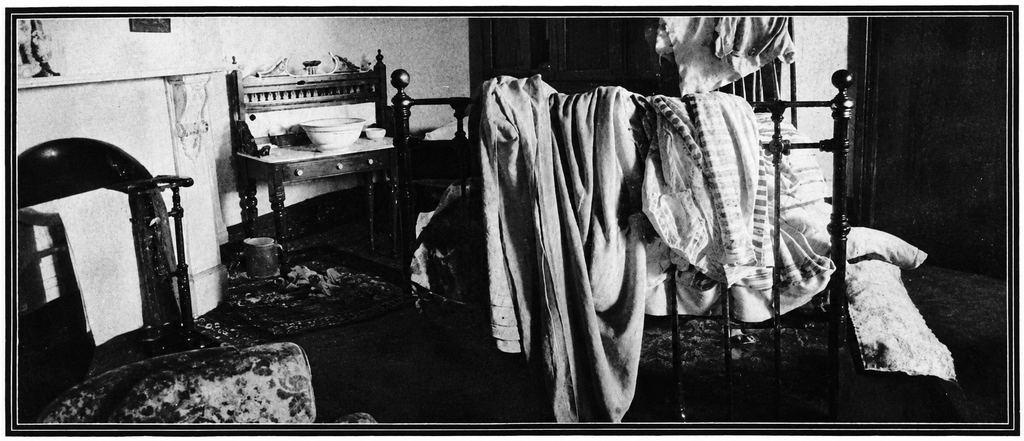
Remarkably, contemporary photographs survive of Room 3 before the scene had been disturbed.
One appeared across the front page of the Sunday Times on 13 February (image above). The newspaper explained that the bolster and pillow visible to the right of the bed marked approximately where Lillian had been discovered. Daniel had been found on the hearthrug near the washstand.
Dr Williams, Fremantle’s District Medical Officer, examined both bodies at the hotel and later conducted post-mortem examinations.
He concluded that Lillian had died from suffocation. He observed bruising around her chin, neck and windpipe and an abrasion on her neck that suggested an attempt may also have been made to strangle her. His post-mortem findings led him to conclude that something had been forced into her mouth.
Daniel had suffered a severe wound to the throat, inflicted with a sharp instrument. Dr Williams concluded that the three-year-old had died from haemorrhage and shock.
Otherwise, he said, Daniel had been well nourished and healthy.
“I found everything normal in the child,” he told the inquest, “except the fact that he had had his throat cut.”
Around them were the remnants of the previous night.
Police found a large suitcase and a smaller attaché case. In the wardrobe were six empty beer bottles; another five empty bottles and one full bottle were elsewhere in the room.
There was a man’s coat and a torn piece of shirt.
Inside the luggage and around the room were letters and other belongings.
Police also found a blood-stained shirt, cartridges, a white-handled razor and a revolver case.
But the revolver itself was missing.
The washstand and basin would become particularly important at this point in the investigation.
Detectives suspected that whoever committed the murders may have used the basin before leaving.
What they could establish scientifically was that Jack Thomas had handled it.
Who was Mr Martin?
At first, police did not know the identities of the dead.
The hotel register said Martin.
Early reports consequently identified Lillian incorrectly and described the missing man as her husband.
Investigators soon traced the party back to the Newcastle Street lodging house.
The proprietor, Annie Andrew, identified the woman and child.
They were Lillian Martin and her son Daniel.
And the man who had occupied Room 3 with them was not Felix Martin.
Police believed he was Jack Thomas.
Felix went to the Fremantle morgue the following morning and formally identified his wife and son.
The Sunday Times described him sobbing as he made the identification.
The search for Jack Thomas began.
Where was Jack Thomas?
Police circulated a remarkably detailed description.
Thomas was around 5 feet 7½ inches tall, thick-set and round-shouldered, with brown hair greying at the temples and a straggling brown moustache with a ginger tinge. He had a small mole or wart beneath his left eye and walked with his feet apart.
He was believed to be carrying a revolver.
Detectives followed reported sightings. One placed a man resembling Thomas on the Rockingham Road. Other reports came from considerably farther afield.
None led to him.
As the days passed, investigators began considering another possibility.
Perhaps Thomas was already dead.
On the afternoon of Saturday, 12 February, a man walking along the South Perth foreshore noticed a body lying among rushes a few hundred yards from Mends Street Jetty.
Constable Edward Richardson attended.
The body appeared to be that of Jack Thomas.
Beside it was a five-chambered revolver.
Nearby lay a copy of the West Australian dated 8 February.
In Thomas’s clothing police found cash, a savings-bank book and a ferry ticket dated 8 February. There were also cloakroom tickets corresponding with a bicycle, swag and Daniel’s tricycle that had been deposited at Perth railway station.
The police search was over.
The evidence would now be tested at an inquest.
Fingerprints in Room 3
Among the investigators who entered Room 3 on 8 February was Detective-Sergeant Edmunds, a fingerprint expert.
He took possession of beer bottles and the wash jug and basin.
The objects were treated with powder to reveal impressions, and the resulting marks were photographed.
Edmunds also obtained Lillian’s fingerprints after her death.
They did not provide a match.
After Thomas’s body was discovered, Edmunds went to the Perth Hospital morgue on 13 February and took fingerprints from Thomas’s hands.
He then compared them with the impressions recovered from Room 3.
There was a match.
An impression on the washbasin corresponded with Thomas’s right middle finger.
Four further impressions on three of the beer bottles also corresponded with Thomas.
Edmunds told the inquest he was certain Thomas had handled the basin and those bottles.
The distinction is important.
When Truth reported the inquest on 5 March, it dramatically announced:
“PRINTS FROM DEAD FINGERS CONVICT THOMAS!”
The newspaper described the fingerprints as the evidence that had conclusively established Thomas as the murderer.
The actual fingerprint evidence was narrower than the headline suggested.
It established that Thomas had handled objects in Room 3—including the washbasin. It did not, on its own, prove what he had done inside the room.
But the fingerprints were only one part of the case.
Two keys recovered from Thomas fitted the large suitcase left in Room 3.
The number on the revolver case found among the belongings corresponded with the revolver discovered beside Thomas’s body.
The cloakroom tickets connected him with the belongings deposited at Perth railway station.
Witnesses placed him in Room 3 on the morning of 8 February and saw him leave the hotel shortly afterwards.
And among the papers examined by investigators were letters that would generate intense speculation about motive.
Was jealousy the motive?
One letter found among Lillian’s belongings had been written by a man living in the country and invited her to travel to England with him.
Newspapers quickly constructed a possible explanation.
Perhaps Thomas had discovered the letter. Perhaps Lillian intended to leave. Perhaps jealousy led to an argument and then murder.
Evidence suggested Thomas could be jealous.
Keely had heard his earlier threat concerning another man. Moody had interpreted Thomas’s behaviour at Rockingham as jealousy.
Thomas’s own surviving letter adds another piece to that picture, although it needs to be interpreted carefully.
Only three weeks before the murders, he had written to Lillian expressing considerable concern about her failure to answer his letters. He had repeatedly visited the Mandurah post office looking for a reply and could not understand her silence.
Lillian’s surviving letter, meanwhile, demonstrated affection between them and that she had turned to Thomas for financial help while Felix was in hospital.
None of that tells us what happened in Room 3.
No suicide note was found.
Nobody survived the room who could explain what occurred between the party’s return to the hotel at about 10.30 p.m. and Thomas’s departure the following morning.
The newspapers’ jealousy theory was plausible.
It was never definitively established.
The Verdict
The inquiry into all three deaths concluded at Fremantle Courthouse on 1 March 1927 before Acting Coroner J. E. Geary.
Medical evidence also corrected one assumption that had dominated the days immediately after the murders.
Thomas had not spent the following four days hiding from police.
Dr Guido Mayrhofer examined Thomas’s body on 13 February and believed he had already been dead for five or six days.
Early newspaper reports had stated that Thomas had shot himself in the head.
The post-mortem evidence showed otherwise.
Mayrhofer found that the bullet had entered Thomas’s chest, penetrated the lung and lodged near the spinal column. He considered that the wound could have been self-inflicted.
The coroner ultimately concluded that Thomas had died near Mends Street Jetty on 8 February.
His findings left no ambiguity about legal responsibility for the deaths at the Federal.
Lillian Josephine Martin had died during the night of 7 February or early morning of 8 February in Room 3 of the Federal Hotel after being suffocated or strangled by John Thomas.
Thomas had wilfully murdered her.
Daniel Charles Martin had died in the same room after Thomas cut his throat.
Thomas had wilfully murdered him.
John Thomas had subsequently died near Mends Street Jetty, South Perth, by shooting himself.
What the coroner could not tell anyone was why.
The woman behind the headlines
The newspapers of February 1927 devoted enormous space to the Federal Hotel murders.
And much of that space was devoted to judging Lillian.
Her drinking was discussed. Her smoking was mentioned. Her relationships were scrutinised. Newspapers described her life as “sordid” and “careless” and turned the circumstances of her marriage into public entertainment.
Jack Thomas became the mysterious fugitive.
Felix became the wounded returned soldier.
Daniel became the innocent child everyone loved.
Lillian was more complicated, and consequently received less sympathy.
Nearly a century later, the surviving records allow us to see something beyond those headlines.
She was Lillie Josephine Bentley, born at Peak Hill in 1902.
She was a publican’s daughter.
At about twenty she married Felix Martin.
At twenty-one she became Daniel’s mother.
Two years later she gave birth to Joan Elizabeth, who survived for only a month.
And now we have something more personal than the newspaper descriptions.
Only weeks before her death, Lillian described herself as struggling to find work while her husband remained in hospital. She was worried about money. She felt unable to turn to her family for help. She wrote affectionately of her little boy.
Whatever mistakes she had made and whatever the state of her relationships, those are her own words—not a reporter’s judgement written after she was dead.
Her marriage had become troubled. By January 1927 it was breaking apart.
And at the age of just 24, she arrived at a Fremantle hotel with her three-year-old son.
Neither would leave alive.
Daniel—“Tyke” to the people who knew him around Newcastle Street—was three years old. His photograph survives because newspapers published it after his murder and, poignantly, because before any of this happened his family had entered his photograph in a newspaper baby competition.
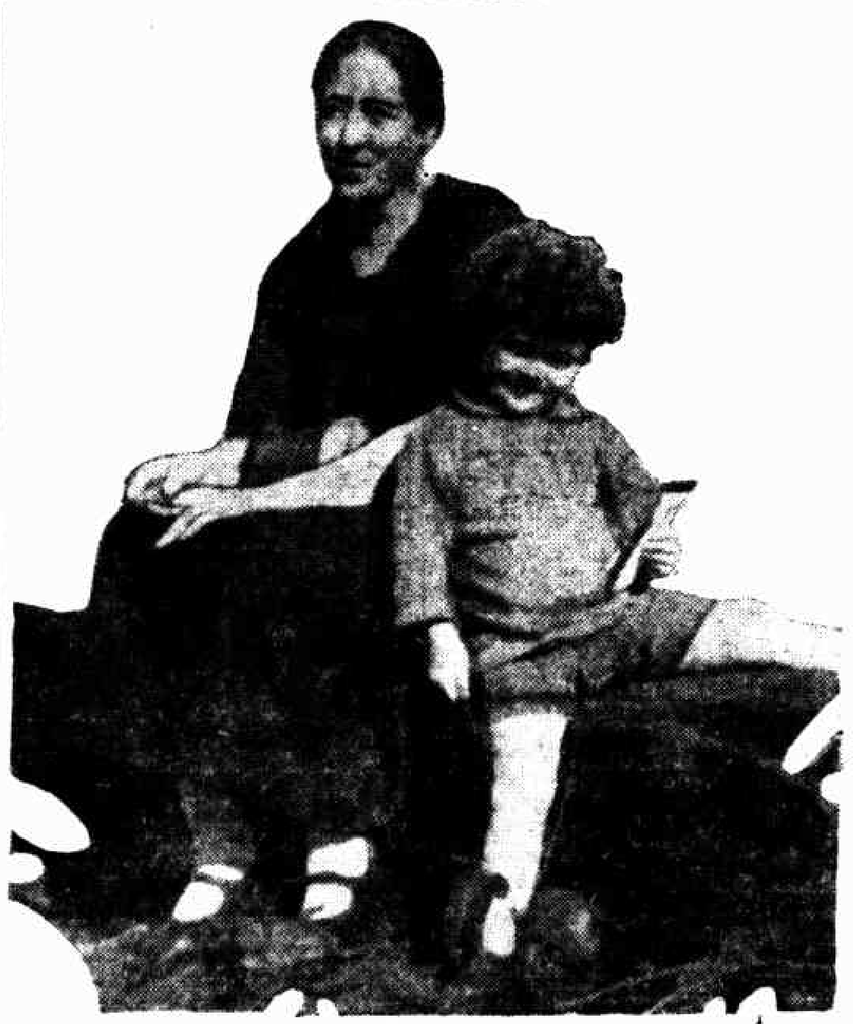
Another photograph published by Truth after the inquest shows Daniel standing beside his maternal grandmother.
The newspaper published it beneath the heading “PATHETIC!”, defining the photograph entirely through what had happened to him.
Viewed outside that headline, however, it is simply a surviving family photograph: a grandmother and her small grandson, taken before Room 3 made their faces newsworthy.
Room 3
Perhaps the most extraordinary surviving record of the case is not a police statement, an inquest transcript or a newspaper description.
It is a photograph.
Room 3 was photographed before its contents were disturbed.
The image published in the Sunday Times shows an ordinary hotel bedroom: iron bedstead, washstand, basin, chairs, clothing and bedding.
Nothing about the room itself explains what happened there.
But almost everything investigators needed was contained within it.
The luggage helped connect Thomas to the room.
The revolver case would be linked to the weapon beside his body.
The letters revealed relationships far more complicated than the names written in the hotel register suggested.
The beer bottles and washbasin carried his fingerprints.
And the testimony of the people working and sleeping around Room 3 allows the final hours to be reconstructed with unusual precision.
At 12.57 a.m., Captain Winzar in the adjoining room heard something heavy fall.
The next morning Bertha Bangs opened the bedroom door and encountered Thomas standing in the darkness.
At about 7.30, he walked downstairs, wished John McDonald good morning and remarked upon the weather.
Within roughly an hour, a ferry ticket was issued that would later be found with his body at South Perth.
At 10.30, Bangs returned to Room 3 and found the door locked.
At about 11.45, she and McDonald looked through the balcony window.
Then the police were called.
It is a remarkably detailed historical trail.
Yet the one thing it cannot tell us is what was said or done behind the closed door of Room 3.
The Federal Hotel register preserved only the mundane beginning of the story:
a man, a woman and a child requiring a room for the night.
They arrived on Monday, 7 February 1927.
By Tuesday morning, Room 3 had become part of Fremantle’s history.