
The Woman the Law Wouldn’t Let Run a Pub
Esther McGrath and Port Adelaide’s British Hotel
For twenty years, sisters Esther and Elizabeth McGrath ran one of Port Adelaide’s best-known hotels. They served its customers, lived within its walls and kept the British Hotel trading through the Depression and enormous changes along the Port Adelaide waterfront.
But for the first several years after their father’s death, there was one thing they could not legally do: change the hotel licence into Esther’s name.
At the time, South Australian licensing law prevented a single woman from holding a publican’s licence. And Esther McGrath was unmarried. So while the McGrath sisters could run the British Hotel, the law required a man’s name on the hotel licence.
For this to change, it would take an amendment to South Australia’s licensing laws. And when it finally did, Esther McGrath was among the first women to benefit.
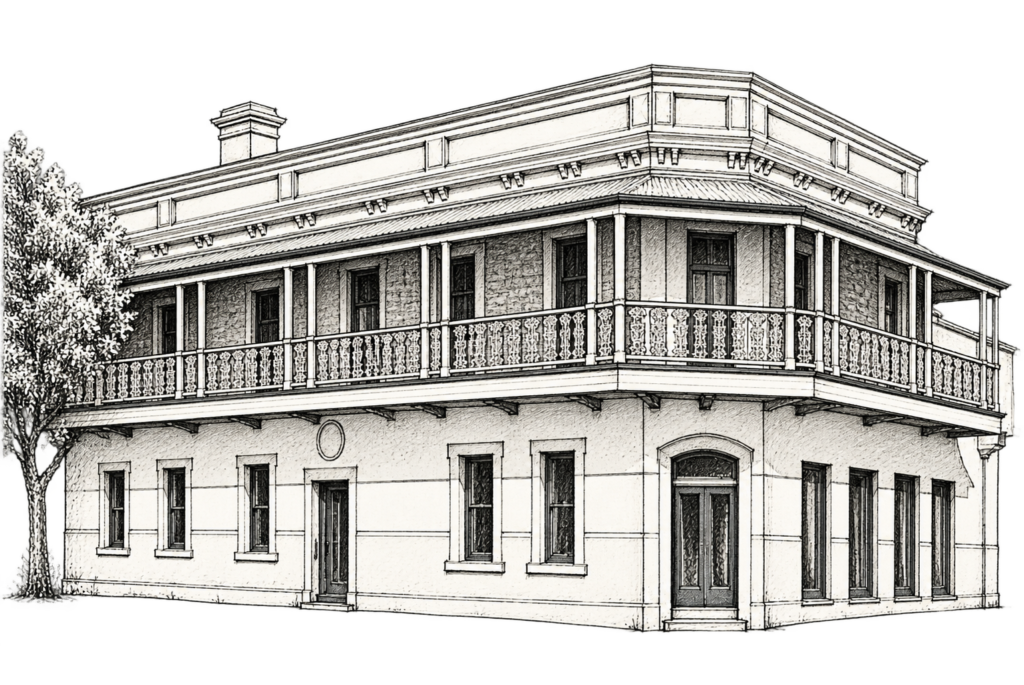
McGrath’s British Hotel
The McGrath family’s association with the British Hotel began in 1907.
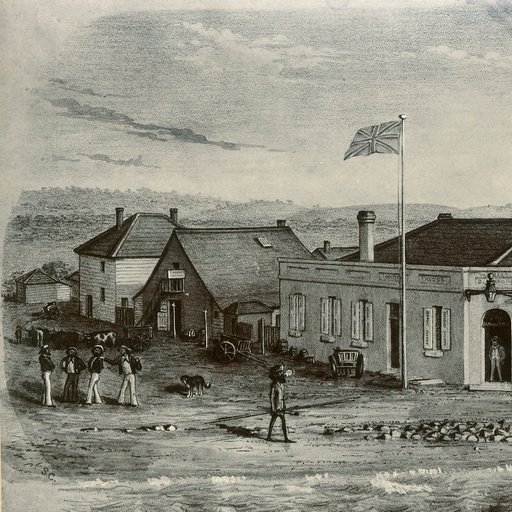
By then, the hotel on the corner of North Parade and Nelson Street was already an old Port Adelaide institution. Its history stretched back to 1847, when the British Hotel was established following the great fire that swept North Parade earlier that year. Later, when it was associated with Sir Henry Ayers, the building was substantially rebuilt in the 1870s, acquiring its second storey.
In February 1907, an advertisement announced that J. McGrath was now in possession of the British Hotel, having previously held the licence for the Australian Pride Hotel.
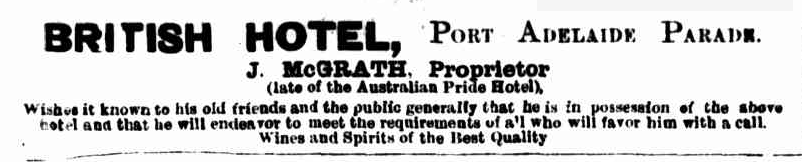
Born around 1854, he arrived in South Australia aboard the Lady Jocelyn in 1876. By his 75th birthday in 1929, the Advertiser reported that he had lived at Port Adelaide for more than half a century and had spent many years keeping licensed premises.
The British Hotel was particularly well placed for the Port’s working population. In 1926 it was advertised as one of Port Adelaide’s best-known hotels, situated opposite Queen’s Wharf and “most favourably situated for its bar trade”.
It was more than John McGrath’s business. It was the family’s home.
He shared the hotel business with his wife, Esther Lawrence McGrath, who died in 1922, with her funeral leaving from the British Hotel. Their children grew up in the British Hotel, including John Henry, Esther Catherine and Elizabeth Caroline McGrath. Esther was born in Port Adelaide in 1896 and Elizabeth in 1900.
The daughters grew up in the world of the Port and, for much of their youth and adulthood, in their father’s hotel.
By the late 1920s, John McGrath had become something of an institution himself. In 1928, Sport described him as the “father of hotel-keepers in the district”, noting his long association with the British Hotel and his involvement with the Licensed Victuallers’ Association. He apparently intended to remain at the British for life.
And he did.
A pub his daughters could run – but could not licence
John McGrath died in August 1932, his funeral leaving from his late residence, the British Hotel.
Esther and Elizabeth continued in the footsteps of their father, running the British Hotel.
That might sound unremarkable. Women had been deeply involved in Australian hotels from the colonial period onwards — as wives, daughters, widows, barmaids, managers and publicans. But licensing law differed considerably between Australian states and over time.
South Australia had taken a particularly restrictive approach.
The legislation governing the British Hotel stipulated that an application for a grant, renewal or transfer of a publican’s or wine licence to a single female was not permitted, except for women protected by transitional provisions. The restriction was later expressly extended so that, for the provision, “single female” included a widow, although some widows retained exemptions connected with licences already held by themselves or their deceased husbands.
By the 1932 consolidation of the Licensing Act, the discrimination was unmistakable. Section 86 stated that an application for a publican’s or wine licence by a woman who was “single or a widow” was not to be entertained unless she fell within specified exemptions.
Esther and Elizabeth were single women.
Their experience and ability to operate the British Hotel did not alter that fact in the eyes of the law.
The brother who made it legal
The solution was John Henry McGrath.
Decades later, when Esther and Elizabeth finally retired from the British Hotel, Esther explained what had happened.
Their father had died in 1932, and the sisters had carried on the hotel. But because neither could legally hold a licence, their brother John left his home at Birkenhead and moved into the British Hotel.
His presence enabled his sisters to remain in business. It was an extraordinary sacrifice as John moved away from his family home, including his wife and young children.
The sisters were running the hotel, but their brother held the licence. The arrangement between the siblings lasted for several years.
And it illustrates something that can easily disappear from the historical record when we rely only upon licensing registers. The name recorded as licensee was not necessarily the person doing most of the work of running a hotel. Women could be central to a pub’s operation while remaining largely invisible in the official record.
Women, alcohol and responsibility
The licensing restriction was part of a broader history of attempts to regulate women’s place within Australian hotels.
South Australia’s licensing laws did not concern themselves only with female licensees. They also tightly controlled the employment of women behind the bar.
The legislation created a system of registered existing barmaids and restricted the employment of women serving liquor. Existing barmaids could remain within the occupation if registered, while the law severely limited the entry of new women into bar work.
The distinction between different categories of women is revealing.
A woman’s ability to participate in the hotel trade could depend not simply upon her competence or experience but upon whether she was a wife, daughter, widow or unmarried woman, and upon whether she had entered the trade before a particular legislative cut-off date.
The Australian colonies and states did not approach female publicans uniformly. Historical research has found striking differences between jurisdictions: Victoria, for example, had a particularly large number of female licensees around the turn of the century, while South Australia, Tasmania and New South Wales imposed much tighter restrictions upon unmarried women.
1935: The law finally changes
Three years after John McGrath’s death, the situation changed.
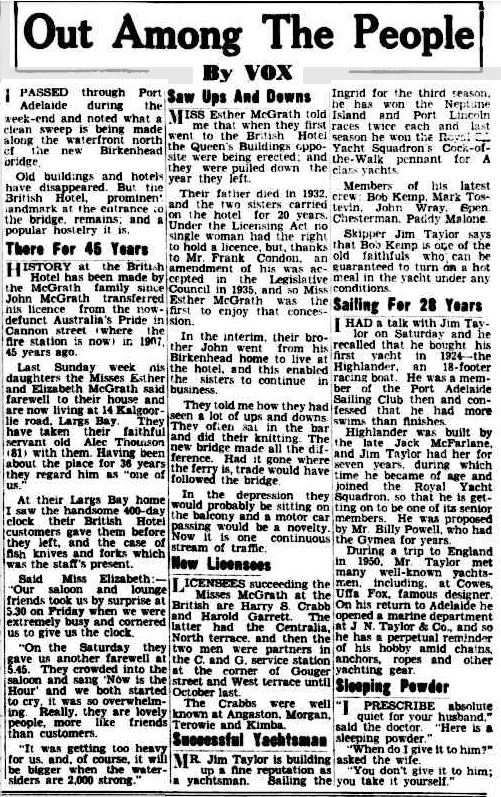
According to Esther’s later account, politician Frank Condon successfully moved an amendment in the Legislative Council in 1935 that removed the barrier preventing a single woman from holding the licence.
For Esther, the effect was personal and immediate. She no longer needed her brother to act as licensee simply because she had never married.
The licensing records provide the bureaucratic conclusion to a much larger story. In September 1936, the licence of the British Hotel was transferred from John H. McGrath to Esther C. McGrath. After years of helping to run the hotel, Esther McGrath could finally become its licensee in her own name.
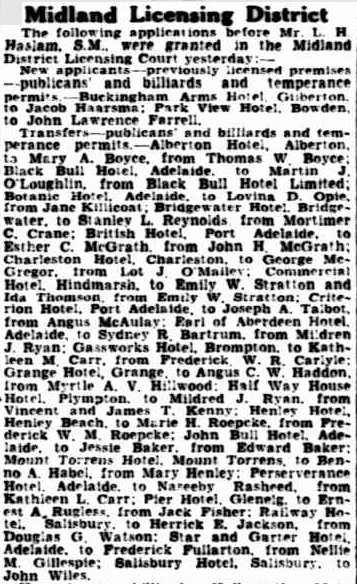
When the Advertiser looked back on the sisters’ career in 1952, it described Esther as the first woman to benefit from the legislative change.
There is a lovely irony in the story.
Nothing about Esther’s ability to run the British Hotel had changed between 1932 and 1936.
The law had.
Twenty years behind the bar
Esther and Elizabeth continued together at the British Hotel until 1952.
During the decades Esther and Elizabeth were part of the British Hotel, they witnessed extraordinary changes in Port Adelaide.
In the early days of the McGraths at the hotel, the rare passing of a motor car was enough to attract attention. By the time they left, traffic outside had become a continuous stream. They had also witnessed the waterfront around them changing. When the Advertiser visited in 1952, old buildings and hotels were disappearing near the new Birkenhead Bridge, while the British Hotel remained a prominent landmark.
The sisters’ life behind the bar also offers wonderfully ordinary glimpses, as they recall sitting in the bar knitting.
When they finally retired, their customers showed just how much the two women had become part of the hotel and community, giving them gifts and throwing farewell parties. “They are lovely people, more like friends than customers.” ~ Esther McGrath
The sisters even took 81-year-old former employee Alec Thomson with them to their new home at Largs Bay. He worked at the British for 36 years and, as they simply explained, they regarded him as “one of us.”
The name above the door
There is a temptation when researching historic pubs to just follow the names in licensing registers.
Licence transferred from one man to another.
Licence renewed.
Licence transferred again.
But the story of Esther and Elizabeth McGrath shows why those records sometimes conceal as much as they reveal.
After their father died in 1932, the sisters ran the British Hotel. Yet because they were unmarried women, neither could simply take his place on the licence. Their brother John had to move into the hotel and become the legal licensee so that the business could continue.
For several years, the official record therefore told only part of the story.
Then the law changed.
In 1936 the same woman who had already been helping to operate the British Hotel could finally have her own name recorded as its licensee.
Esther and Elizabeth remained there until 1952, ending a McGrath association with the British Hotel that had begun with their father 45 years earlier.
Their customers gave them a clock when they left.
It was an appropriate gift.
Because the story of the McGrath sisters and the British Hotel is, ultimately, a story about time — about a hotel that survived while the waterfront around it changed, about two sisters who spent decades behind its bar, and about a law that took rather longer to catch up with the women already doing the work.
